Monday, 31 October 2011

I had a meeting with my supervisor for my fourth year project. He alternated between saying "I have no expectations of you, don't worry" and "you have the scope to get more out of this than just a project" and "this is part of something I'm being funded for" but "I have no expectations"...

...so yes, I am worried, actually! I'd prefer if he told me what his expectations were so I could try to live up to them. Oh well. I'm sure it will be fine.

Thursday, 26 May 2011

Arrays and networks and brains, oh my :D

I don't have time to write about it properly, but this paper - the new transcriptome study of autism-spectrum brains, from Nature, makes me really excited. Comparing gene expression in a high throughput way, using microarrays - creating networks and identifying significant modules - using genome-wide association study data to back up your conclusions - this is awesome. This is the point of an entire module of my course this year! (1)

More to the point, this is kinda the point of the systems biology course I'm going to be doing next year. This is what I want to be doing. I haven't had a chance to look at the paper more critically yet, but I really hope it stands up to thorough analyses and follow-up work, because I think it showcases perfectly what new technologies and systems-level approaches can do. I hope that I'll see more of this kind of integrative study in future!

And now, back to the cave of revision... See you in two weeks!

(1) "Human genetics, genomics, and systems biology". Yeaaaahhh. I need to reference this paper in the exam!
-------
Reference:
'Transcriptomic analysis of autistic brain reveals convergent molecular pathology', Irina Voineagu, Xinchen Wang, Patrick Johnston, Jennifer K. Lowe, Yuan Tian, Steve Horvath, Jonathan Mill, Rita M. Cantor, Benjamin J. Blencowe & Daniel H. Geschwind, Nature (2011), doi:10.1038/nature10110

Thursday, 28 April 2011

Aspirations


Yesterday, I gave a tour of the department to a thirteen year old and her mother. When I was thirteen, I wanted to be a costume designer for films (blame Lord of the Rings).

No, the girl wasn’t some kind of prodigy (although she did seem pretty smart). Her mum just emailed the head of the department, saying her daughter was interested in science and the university, and they were going to be in the area, so could they come and have a look? And he passed it on, and I volunteered. I was impressed, to be honest, that the girl had that much of an idea of what she wanted to do and was keen enough to want to find out more, which is why I offered to show her around. That, and it was a good break from revising, and it was a chance to practice talking about science to non-experts.

Thursday, 14 April 2011

Blood groups and bruises

Fig 1: I has a bruise.
I went to give blood last Thursday. Giving blood is something I feel quite strongly about, so I try to go as often as I can. Sadly I hadn't been in about a year - but I persuaded a friend to come and donate, too, so I felt less guilty! Unfortunately this time, for me, it didn't go too smoothly. I didn't actually manage to give blood, because the needle went in wrong. Hence the bruise. So I'm going back in a couple of weeks.

After you first give blood, you are sent a donor card, which tells you your blood type. I'm O+ - this was a bit of a surprise to me, as both my parents are A+! A quick Google cleared up why: the A blood group is inherited dominantly, so it's possible for someone to carry one copy of a gene that produces the A antigen, and one copy that doesn't, and still have the A blood group (they are heterozygous). So, both of my parents must carry an A allele and an O allele. (Blood types have actually been used to clear up paternity disputes, before more detailed genetic information was easily available.)

But what do these A, O (and B) things actually mean?

Sunday, 20 March 2011

Baking is science for hungry people! :D

Term is over, my lab project is over (well, the part that involves being in the lab is at least, if not the write-up) - and so to celebrate, I made C .elegans cake!

Fig 1: Caaaaaaake. Photo by me.

Tuesday, 22 February 2011

Worms! Everywhere!

I now have my very own box in the freezer in my project lab. (It has a bright green name sticker on it, because I feel I should keep up my reputation for liking shiny things :P) I feel like I belong there, finally!

Okay, that's an overstatement, but it does feel like my project is finally starting to go somewhere. So far I, and the other girl doing her third year project in the same lab, have spent five weeks doing Western blots over and over again, with various different protocols and equipment and extracts, and to a certain extent it felt like going around in circles. Now, however, we finally have a set up that works well, and tomorrow, perhaps, touch wood, we will have some results.

C. elegans - an adult and a couple that have just hatched. Source.

Sunday, 20 February 2011

How to import a new citation style in LyX

This post is for my own future reference, and for the use of any other users of LyX for Windows, because there seems to be very little documentation out there that doesn't assume a lot of prior knowledge.

I had an extended essay to write over the Christmas holidays: 3000-5000 words, roughly 10% of my final grade, and most relevantly, it needed proper references, and LOTS of them. The guidelines stated citations should use the style found in the journal Cell - Harvard-style referencing, which I personally hate, never mind. The default citation style in LyX is bracketed numbers, like so [1]. It took me some trial and error and far too much time to figure out how to change this, so hopefully this will save other people some bother.

Saturday, 29 January 2011

Making memories


The picture above is of Professor Sir Gabriel Horn, speaking on mechanisms of memory, last Thursday evening. It was a talk I organised for my college's science society, before our annual dinner.

I'm currently the society president, which has been more work than I expected, but also great fun. The lead up to Thursday, for example, involved a cancellation, several different types of adaptor cables to connect a Mac to a projector, a last minute sign up, a seating plan, me having to write an introduction and talk in front of people, last minute placecards, finding a photographer - but on the night itself, everything went remarkably smoothly. Once we were sitting down for dinner, I could relax, and had really quite an interesting evening talking to Gabriel Horn about travel and epigenetics, amongst other things! We did slightly alienate the physicists sitting opposite, though - oops...

Wednesday, 15 December 2010

Climate Change in Comic Form

 This is really cool. But read the comments, too. Basically it's great until the last section, where he over-simplifies and over-sensationalises a bit. Still, it's a really nice, easy to follow, explanation of why not to necessarily listen to the headline on climate change.

EDIT:
Okay, having read the comments I'm annoyed enough by some of them to add this: I don't know all the facts. I don't have the expertise to understand them all, I suspect, nor the time, currently, to read all the evidence. However, I trust the 97.5% of the top 200 climate scientists (although how on Earth they measured that I don't know). In any case, fossil fuels will run out eventually (and so will fuel for nuclear power). The Sun, winds, tides - these won't run out until the human race is long gone. Renewable or green energy sources are worth investing into because they are sustainable, unlike current practices.

I also kinda agree with Drew when he says "The ideas of conservation and renewable resources should not be seen as the only way to save us from global warming. Instead these ideas should be supported because they are the morally responsible thing to do for our planet."  I'm not usually one for bringing morals into scientific debate, but we are doing things to the planet that we don't know the long term effects of, and I for one don't think the risks of continuing unchecked are worth it.

Holidays?

Ahhh, holidays. Or should I say "vacation", because that's what it is >_>

"Vacation". You vacate your room, your college, the city... but not your work! *insert evil laughter from Captain Tripos here* ...sorry, Cambridge reference.

So, my department this year sets us a 3000-5000 word essay to do over the Christmas holidays, which is supposed to be essentially a week of full time work. Woo.  Actually, though, it's almost enjoyable.

Tuesday, 7 December 2010

Aliens in California! ...or not.


You’ve probably heard about it by now. In fact I’m probably late to the party, so to speak, in terms of blogging about this... but never mind. Here it goes... NASA discovers arsenic-loving life! 

But wait, what? It’s from California? Not Mars? And it’s a bacterium? That’s not as exciting as it sounded...

Saturday, 28 August 2010

Viruses vs Cancer!

A paper published in Clinical Cancer Research earlier this month describes a treatment for cancer that utilises the herpes simplex virus to selectively kill cancer cells, while leaving normal human cells intact due to deletions that make it unable to grow in them. I'm almost certain this is the same treatment I heard about in a lecturer's anecdote in first year (obviously quite a way before the study was published):

This group had developed a treatment for cancers of the head and neck, using the herpes virus. The treatment is pretty effective at shrinking tumours and making surgical removal of the remaining tumour possible. They have one patient with a tumour on his tongue, which understandably limits his diet - he probably has to be fed through a tube. So they use this treatment on him, the tumour shrinks, they operate, he's discharged. A few months later, though, he's back - with liver failure.

Friday, 13 August 2010

Error bars

 I am currently about half way though an eight week summer placement in a lab. I'm part of a small group working under one supervisor, in a larger group all doing research with a similar 'theme'. It's remarkably diverse, though. And strangely, each lab seems to have a 'trademark' technique! For example, I have done a lot of real-time PCR. Another summer student in the same building seems to do nothing but western blots. Another is doing a lot of gel-based PCR; others do a lot of tissue culture... I'm not sure if it's just the nature of a summer project, or the nature of the research done in each lab, but it amuses me. And actually, doing nothing but designing and running real-time PCR is suprisingly not that tedious, although I am excited about maybe getting to do some FISH next week (yay, glowing things!).

Thursday, 12 August 2010

Slime Moulds (also, hello)

This is something I learnt about back in first year, and I thought was pretty awesome, so, having written this up previously on a personal journal, I'm reposting it in edited form to hopefully give this new blog a good start :)

Name: Dictyostelium dicoideum

What is it?: Dictyostelium is a unicellular organism... most of the time. It lives in soil, feeding on bacteria which themselves feed on decaying leaf matter (yum). Slime moulds were formerly classed as fungi, since both reproduce by releasing spores. Unlike fungi, however, these single-cell amoebae are able to move around.


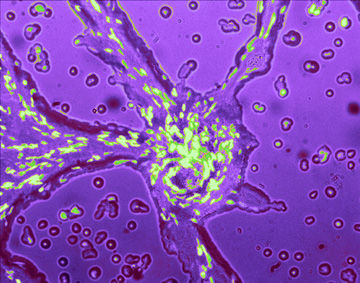
Image: Dictyostelium labelled with GFP, by Richard Firtel, University of
California,San Diego. From the website of Eduardo Kac.